By Joslyn DelSignore, Tristan Hostetter and Scout Nicholson Jambar Contributors
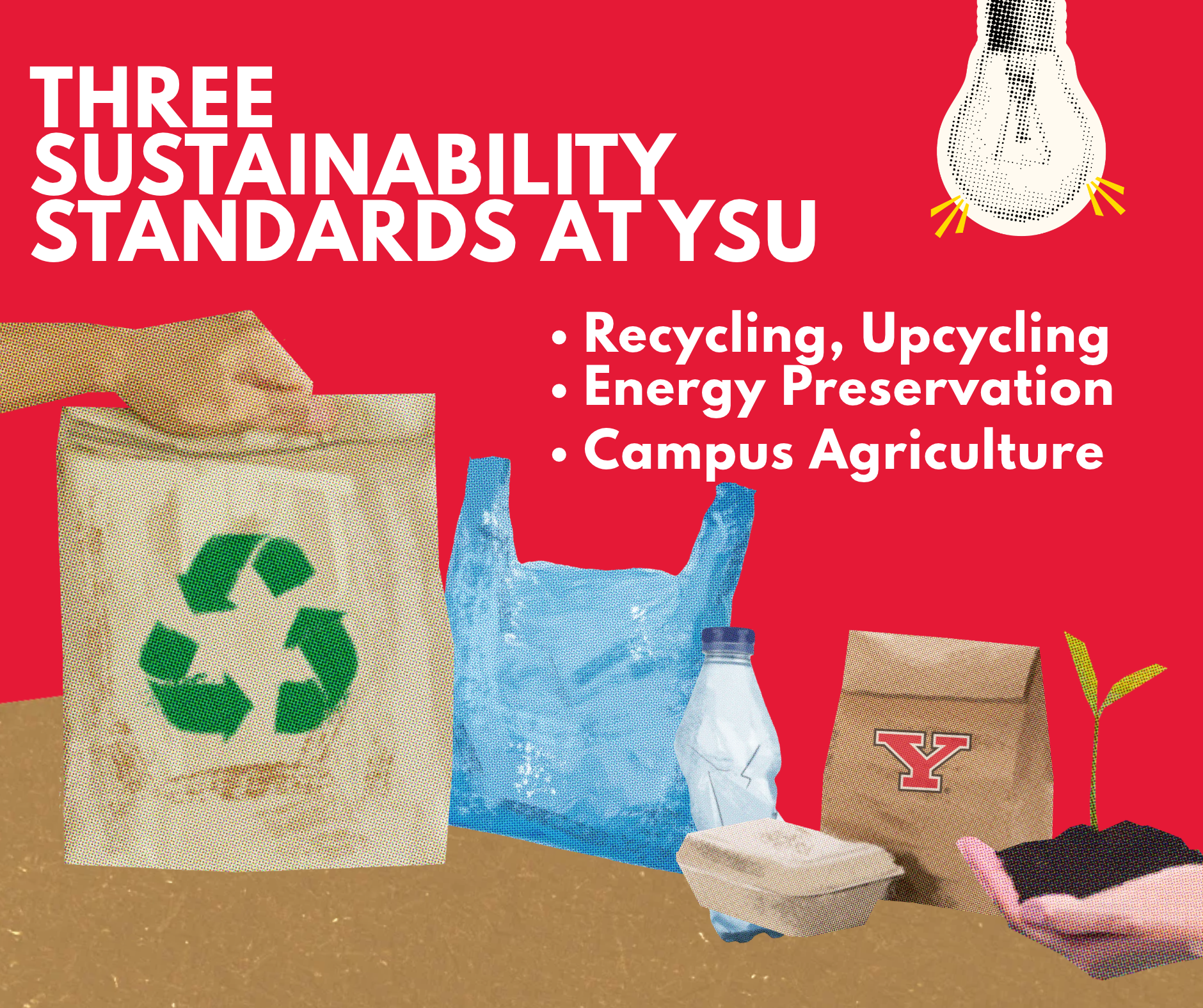
Sustainability at Youngstown State University takes many forms. From recycling to energy usage and planting, students and faculty aim to make YSU — and the world — a cleaner place for the next generation.
YSU Recycling Program Administrator Erica Nielson, said she believes a sustainable world doesn’t always mean recycling a bottle and waiting for it to be shredded, melted and formed into something new. Nielson said upcycling helps cut out the middleman.
“We’re keeping products and materials still in the community while not just throwing it into the landfill and buying a new TV or a new couch,” Nielson said. “We’re doing a lot of repurposing. That’s the biggest thing with sustainability is upcycling and repurposing as much as possible.”
Recycling often brings a better solution than sending products to the landfill, though Nielson said it can also be costly.
“With plastics and papers, every time they break them back down to recreate more paper and plastic, it deteriorates, and it has a finite amount of times that we can reuse it,” Nielson said. “Glass and aluminum and scrap metals, they can be infinitely reused, but that costs a lot, and that takes a lot of fuel and burning the things that we don’t want to burn.”
The YSU Recycling Program works alongside science, technology, engineering and mathematics programs to repurpose metals for the recycling process. The program collects items to give students ways to express themselves through artistic repurposing.
Outside the classroom, she said the program is in talks with AVI Fresh to work toward a future with fewer one-time-use trays and cutlery.
Another response to YSU’s sustainability efforts is finding renewable energy sources to reduce energy consumption.
Jesse Wallace, director of facilities engineering, said the key component is cutting back on lighting and air conditioning in buildings during the summer. This uses less energy when it is at peak demand for everyone else.
“We actually effectively make that happen by scaling back how much our air handlers are running, scaling back lighting in all of the buildings, scaling back the central utility plants, running at a lower capacity, so temperatures rise a little bit in the spaces, but we reduce a significant amount of energy during those periods,” Wallace said.
Lowering the air conditioning may cause discomfort for students, however, Wallace said on warmer days, the facilities office precools the buildings to regulate the temperature.
Some of YSU’s buildings, such as Williamson Hall and the soon-renovated Kilcawley Center, follow what’s called the Leadership in Energy and Environmental Design standard.
According to the U.S. Green Building Council, LEED is the world’s most well-known green building rating system to create healthy, efficient and cost-effective environmentally conscious buildings.
“Another part of LEED is daylight harvesting,” Wallace said. “The Chestnut Room is going to have a lot of glass, so we’re taking that daylight load into account and supplementing some of our lighting needs in that space with that daylight.”
Wallace said this means using Kilcawley’s natural sunlight to cut back on the amount of electricity during the day.
YSU is pushing LED and solar-powered lighting. Wallace said there’s a campuswide initiative to replace lightbulbs with flat panel LEDs, significantly reducing energy consumption.
Wallace said increasing campus renewable energy efforts helps YSU save money.
“It does come down to money. If we can invest in these kinds of sustainability goals that generally do come along with some operational savings, that’s further money that we have to invest in our facilities to make our campus more valuable to the students that we attract,” Wallace said.
Glenn Christopher, manager of The Sandy Simon Greenhouse on Lincoln Avenue and president of the Youngstown Environmental Sustainability Society, said energy usage is an issue in the greenhouse as well.
“We mark temperatures up to 140 degrees [Farenheit], so I don’t know the numbers on our energy usage, but it’s probably pretty bad, which is [a] thing [that’s] kind of contradictory,” Christopher said. “That’s definitely something I would love to see fixed.”
Christopher said YESS focuses on three pillars of sustainability it wishes to improve, including biodiversity, food security and education.
“Biodiversity can be defined as the variation of living organisms that you have in a specific area,” Christopher said. “We focus on putting native plants in [YSU’s] landscape.”
YESS received a $500 grant to redo a rain garden between Coffelt Hall and Fok Hall. Christopher said YESS planted 50 native species that YSU students will be able to see in spring.
Christopher said YESS is also working to improve food insecurity.
“Food security is a big issue not only on campus [but] within Youngstown. It’s kind of like a food desert,” Christopher said. “What we want to do is grow a high volume of vegetables and just donate that to the Penguin Pantry and have them distribute it.”
Christopher said members hope to use the greenhouse to build fresh fruits and vegetables using a hydroponic system, which grows plants in a water-based solution rather than soil.
There are two compost bins outside the greenhouse that students use. Christopher said YESS makes an effort to reuse as many materials as possible.
Christopher said YESS has a goal to educate YSU’s campus sustainability and how the community can make a difference.
YESS hosts Green Penguin Day annually, which Christopher said is its biggest event of the year, where it sells plants grown in the greenhouse and invites vendors and organizations to table.
Profits from Green Penguin Day fund supplies for the greenhouse.
Christopher said he wants students of all majors involved in YSU’s sustainability efforts.
“Everyone lives on the planet, everyone needs it to function well [and] to survive. It’s everyone’s problem really,” Christopher said.
Christopher said anyone is welcome to join YESS, and to contact himself or Felicia Armstrong, faculty adviser, if interested.