By Katelyn Obermiyer Jambar Contributor
From double-spiral notebooks to slightly off “Y” logos and images of Pete the Penguin that don’t match the mascot, new messages representing Youngstown State University don’t always meet brand standards.
The reason for that — artificial intelligence.
AI generates visuals for communication from internal departments and public entities that may not resemble YSU’s brand.
These visuals have university departments considering new recommendations for AI generation to maintain both authenticity and credibility.
Becky Rose, executive director of marketing and communications, said authenticity helps audiences trust a message and communicate its purpose.
“If people don’t trust the message they’re receiving, you’re not gonna hit your goal with what you’re trying to do with your message,” Rose said. “When students are flagging these things, then they’re questioning the authenticity of it, and then that leads to them not trusting the message.”
The flagged elements include generative glitches, also known as visual artifacts, or errors and inconsistencies in an image that do not resemble how the photo’s subjects would look in real life, according to online glossaries Morphic and Cloudinary.
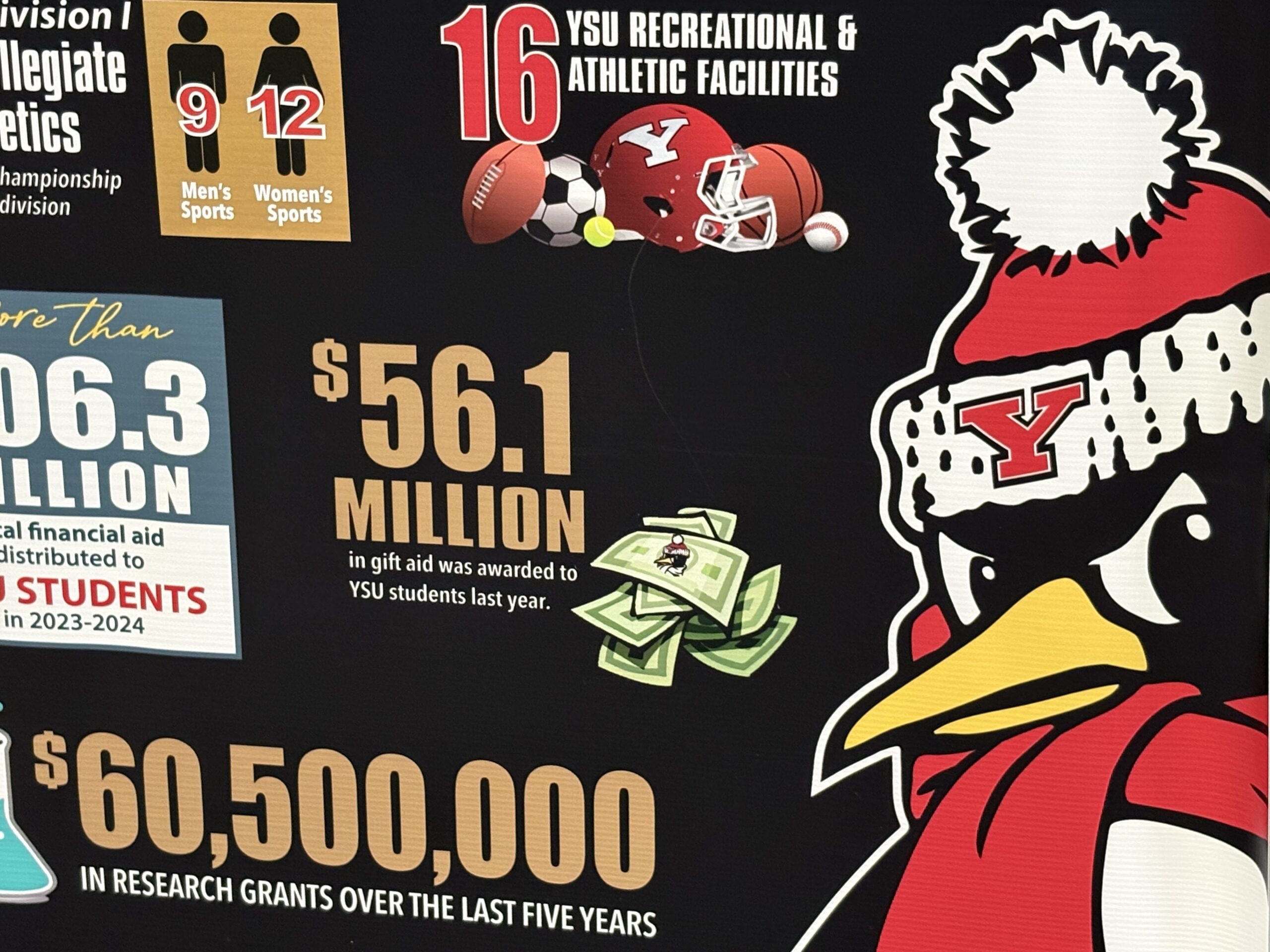
Rose said some of the visual artifacts people have expressed concern over include Pete the Penguin and the shape of “Y” logos, which may prompt audiences to question whether the content is real.
“[People] throw some directives into AI and just tell it to create. Nobody’s gonna create a Pete that looks like our Pete, our mascot, our logo,” Rose said. “We’ve seen some weird looking ‘Y’s, because it’s not quite the right dimensions. … That, again, does not have that authentic feel of what we’re trying to do at the university level. And when you’re putting it out into the community, it raises that question of, ‘Is this real or is it not?’”
If students question whether the content is real or focus on the visual artifacts, Rose said the image’s message may not be interpreted as intended.
“It becomes a negative interaction at that point rather than that positive interaction of signing up for whatever we’re asking them to sign up for, attend whatever event, clicking whatever is in the email,” Rose said. “It becomes more about what was wrong with the image than necessarily what was in the message itself.”
Information Technology Training Services is one department using AI to generate visuals that engage with students and use YSU’s brand.
For its September Tech Talk, the department generated an image of a student on a laptop with several YSU brand elements, such as the block ‘Y’, and a cartoon penguin. The notebook next to the student was generated with two spirals as a visual artifact.
Rosalyn Donaldson, director of IT project management and training services, said she thinks it’s interesting that audience members acknowledge the visual artifacts as they draw attention to the content.
“It’s interesting that people noticed because my understanding is that we send a lot of emails, and through the tool that we use for sending emails, we can see how many people have clicked and engaged with the email,” Donaldson said. “We don’t want to violate our branding regulations and things, but it’s interesting to know that people are having a conversation about it and that our simple messaging has stimulated this kind of interest.”
Kalyn Huff, IT training associate, said she uses generative AI to boost workflow but said individuals must check the content for accuracy and incorrect information.
“The downside is that you have to monitor it. You have to make sure that it produces what you need it to produce, and you have to make sure it’s accurate,” Huff said.
To address consistency with brand visuals and AI generated content, Huff said individuals should tailor prompts with specific brand elements.
“Always prompt with YSU branding in mind,” Huff said. “That’s the best way, that’s the most consistent way and that’s the way that I like to train as a trainer, using our branding, and just being consistent with that across the board.”
Both Rose and Huff said they recommend uploading brand assets, such as Pete the Penguin and YSU logos, to reduce generative errors and maintain consistency. Rose said brand assets can be downloaded at “Creative Branding and Design” through ysu.edu.
“If we’re following the brand standards, and we’re creating pieces that are done with the brand in mind, we’re reinforcing that authenticity and hopefully encouraging that trust with our audience,” Rose said.