By Katelyn Obermiyer / Jambar Contributor
From setting the needle on a record to pushing the buttons of a CD player to digitally hitting the play button, technology has changed how people listen to music over the decades.
Now artificial intelligence is changing the way audio is produced and consumed.
As AI integrates into the field, faculty and students at Youngstown State University are experiencing its benefits, drawbacks and determining what the future sounds like for the industry.
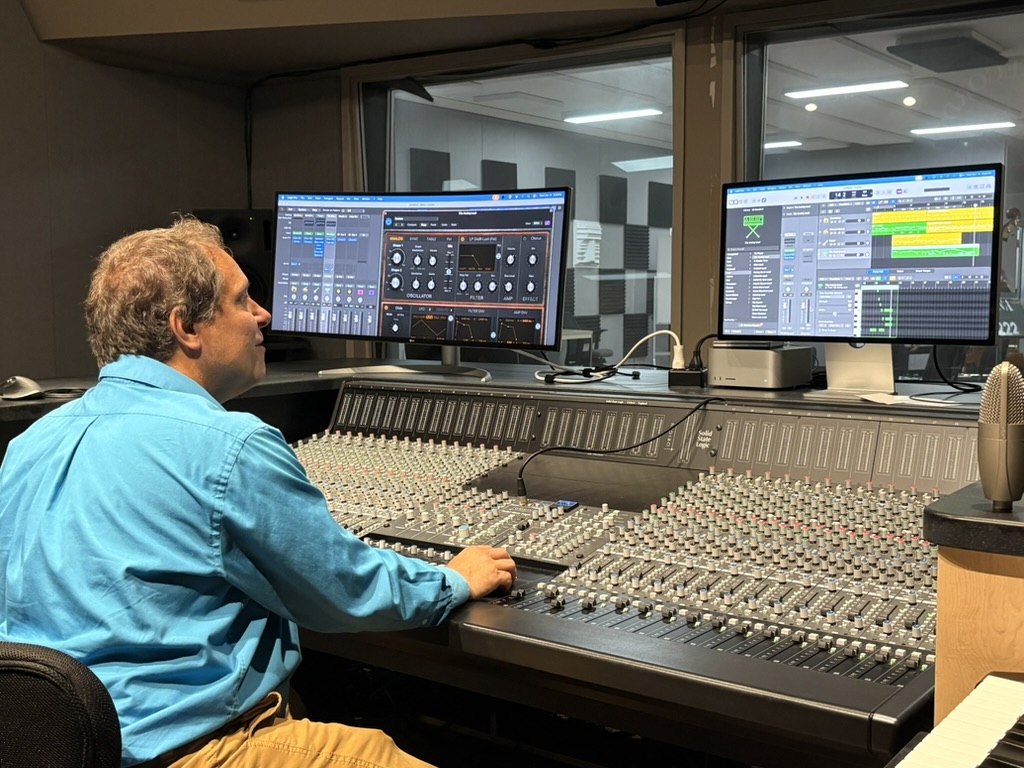
With over 20 years of experience operating a home-recording studio and teaching, Bryan Helsel, lecturer of audio and music production, said AI helps distinguish and isolate layers of sound in recordings, known as splitting stems — a task previously difficult for engineers.
“Prior tools would have been [equalizers] and multiband compressors and gates … that would have allowed us to isolate certain frequencies, but to be able to really have generative AI find, ‘What is the bass guitar?’ and ‘What is the guitar?’ and ‘What is the piano? and ‘What is the vocal?’ That’s pretty incredible,” Helsel said.
However, due to its algorithm, Helsel said AI can cause new music produced to sound similar.
“That’s a little troubling because it’s … using algorithmic, generative things, and it’s looking at styles of music and allowing you to say, ‘This is pop’ or ‘This is R&B’ or ‘This is jazz,’” Helsel said. “[It’s] generating [an] EQ and a volume structure that kind of fits with the kind of standard of what is happening in those genres, but it’s also forcing a lot of music to sound the same in so many ways.”
Edward Sallustio, adjunct professor in audio and music production, said he thinks AI can be used as a tool to speed up production but not replace human contribution.
“Mixing and mastering is a big job when you’re doing it as a human being, and while the AI versions aren’t necessarily that good, they can kind of act as a preset where it’s a starting point. But it still needs human interaction,” Sallustio said. “It’s a tool more than it is a replacement.”
Sallustio said part of the appeal to listening to music, especially live, is a human-to-human connection AI can’t replicate.
“AI is not gonna give you imperfections that a human will,” Sallustio said. “Slight intonation problems, or little mistakes, you know, falling back on a beat, falling ahead of a beat — those are just humanizing qualities that AI is not able to deliver right now.”
Zosia DuPont, sophomore audio and music production major, said she feels AI can help with splitting stems but lacks the ability to create meaningful messages in music.
“It doesn’t have that vision. It doesn’t have that creativity. It doesn’t have that message to it,” DuPont said. “I think that that’s what AI can’t create. It can’t create message, it can’t create intent, it can’t create feeling and that’s what music is.”
As music changes with AI, Helsel said he thinks there needs to be ways to identify music that’s AI generated for people to evaluate.
“While it’s generative, the evolution of music, some of what we teach here is music history … if that training is already kind of embedded into that, I’m concerned about lack of evolution of music and confusion for humans as to which songs they’re hearing on the radio are real and which ones are AI generated,” Helsel said.
Sallustio said one way to identify AI-generated music could be adding a label to streaming platforms, an idea with national support from music groups and artists, according to a July article from Wall Street Journal.
Moving forward, Helsel said he thinks humans will adapt to technological and style shifts based on the historical evolution of music.
“We look at it as a tool, and we have to evolve along with it and just make sure that we’re not still doing this the way we did 10 years ago, because we don’t have to do it [that] way,” Helsel said. “Anytime technology changes, musical styles will change along with it … and humans will find a way to say, ‘I’ve got this tool, and I can use it the way I’m supposed to, or I can misuse it.”