
By Tristan Hostetter / Jambar Contributor
As artificial intelligence becomes more common across the workforce, Youngstown State University has launched a program called “Campus Mentors for AI” to equip faculty with the knowledge to better prepare students for careers that integrate AI.
According to the program overview, the peer mentoring program allows faculty who are “thoughtfully experimenting with generative AI in their own teaching” to guide colleagues with questions about AI use in the classroom.
The program is in its second year, with the overview citing a guiding idea — faculty trusts faculty.
Program Facilitator Rachel Faerber-Ovaska said having mentors within departments on campus reduces the need to look elsewhere for information.
“It’s people you already know, and you trust, and maybe you admire, in a way,” Faerber-Ovaska said. “They’re your colleagues who happen to be people who were already interested in learning about AI and are maybe, well, they’re clearly a few steps ahead.”
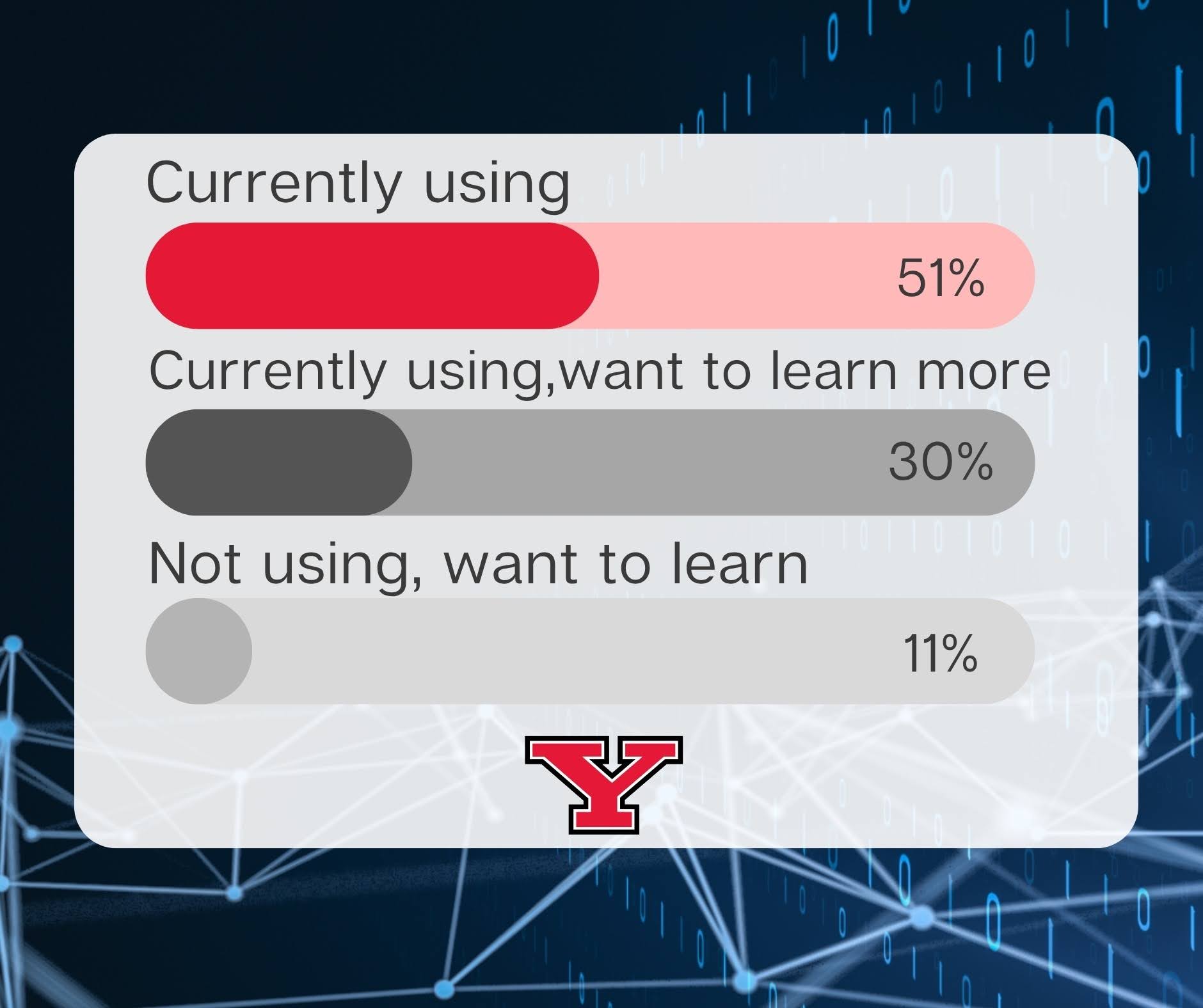
Roughly 66% of YSU professors completed an internal survey about AI use in their work. Of those, more than 90% said they either use it now or want to learn more about how to use it, according to Alan Tomhave, chair of the committee for AI Across the Curriculum committee.
“We had 51% currently saying, ‘Yeah, I use it in my work.’ 30% said, ‘Yeah, I use it on my work, but I want to know more.’ An additional 11% said, ‘No, I don’t use it in my work, but I want to know more,’” Tomhave said. “It’s an overwhelming majority of the respondents saying, ‘Yeah, I need to do more.’”
Tomhave also said students’ data privacy is a focus to ensure private information is not submitted through insecure AI software.
Faerber-Ovaska said faculty pushback to the technology stems from environmental concerns and the belief that not all classrooms would benefit.
Dana Sperry, professor of digital media and former AI mentor, said some classrooms should not use the technology at all.
“I think that students need to figure out how to, for instance, have a discussion [in] class where there’s no AI, and you have to think on your own, and talk on your own to other human beings, and they have to talk back to you, right? That’s a skill,” Sperry said.
In contrast, Sperry said not equipping students with some knowledge of large language models, such as Claude or ChatGPT, would be a disservice as they enter the workforce.
“I just looked at a job announcement, and they were listing programs, and … Claude and [ChatGPT] were in there, and I was like, ‘Yeah, that seems about right,’” Sperry said. “But that means they’re expecting students to have experience with it and be able to fold that into their workflow, so then we need to teach them how to fold that into the workflow.”
With concerns students use AI to circumvent learning, Hillary Fuhrman, assistant provost for teaching and learning, said the university is adapting policy to better suit how it’s used on campus.
“I think many faculty see it as a really powerful learning tool and, at the same time, concern about it being used as an easy button rather than engaging in the productive struggle of learning,” Fuhrman said.
Professors have the option within a syllabus to permit levels of AI use, whether that be no use, some use or open use. Academic integrity policies already prohibit students from presenting outsourced work as their own.
The program is sponsored by YSU Online, the Institute of Teaching and Learning and IT Training Services. The departments collectively offer each mentor a $500-per-semester stipend and a letter of recognition. The program began in fall 2025, with four professors participating in the first year.
Faerber-Ovaska said more have submitted to become peer mentors this semester, and the number of mentors each semester is expected to grow.

Faculty can serve as a mentor for one semester, with the possibility of a second semester upon mutual agreement with program facilitators.